
Airsoft Strategy: The Tactics That Actually Win Games
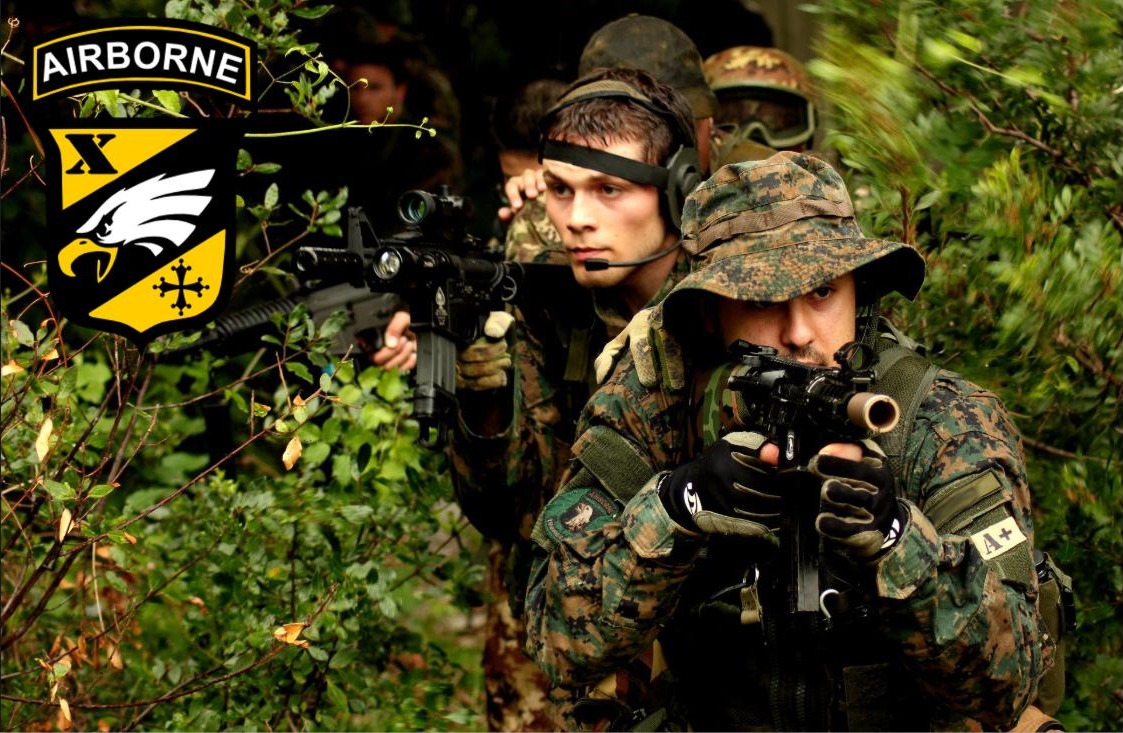
Most "airsoft tips" articles are really gun-buying guides wearing a strategy hat. That's backwards. The players who consistently win rounds aren't the ones with the fastest trigger fingers — they're the ones who move correctly, use their team, and don't do dumb things with their bodies in the open. None of that costs money. This is a real breakdown of the tactics that actually matter, built from published military doctrine that airsoft's own milsim community openly adapts, plus guides from airsoft retailers, fields and instructors who've clearly done this a lot. Where something couldn't be verified, we've left it out rather than guess.
Cover vs. Concealment — the Distinction Most Players Never Learn
Real infantry doctrine draws a hard line between the two: cover stops a projectile, concealment only hides you from view. A brick wall is cover. A bush is concealment. This split comes straight from US Army field manuals — FM 21-75, Combat Skills of the Soldier, dedicates its first chapter to it — and organized milsim communities like UNITAF's Force Manual teach it the same way for simulated play.
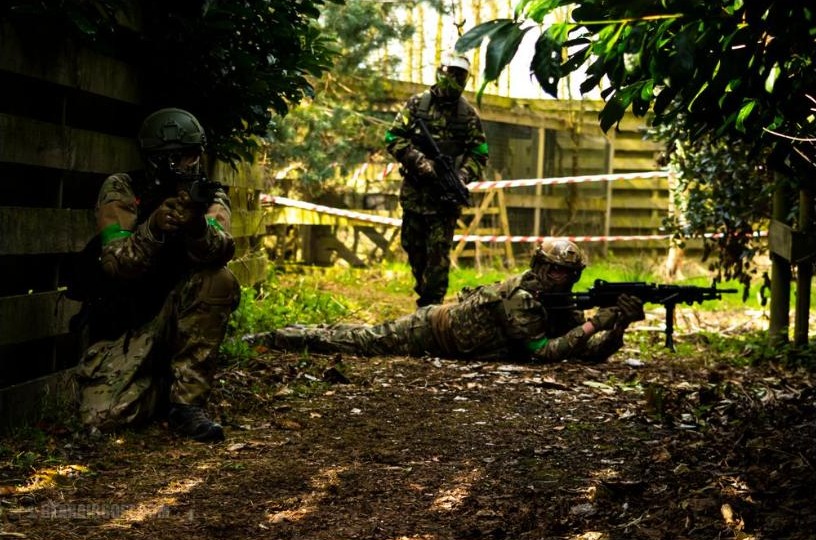
In airsoft the stakes are obviously different — a 6mm BB won't punch through a wooden pallet the way a rifle round would — which means plenty of "concealment" objects (bushes, thin plywood, a hanging tarp) function as perfectly good cover against BBs specifically, even though they wouldn't in a real firefight. That's not an excuse to stop thinking about it, though. The point of the distinction still holds: know whether the thing you're crouched behind actually blocks line of sight and line of fire, or just makes you feel hidden while you're standing in the open. Sightlines don't care how you feel.
Movement: Bounding Overwatch, Fire and Maneuver, Flanking
Bounding overwatch is the core movement technique for crossing open ground as a team: one element holds a position and watches while the other advances to the next covered spot, then the roles swap. UNITAF's manual splits it into two flavors — "successive" bounding, where the trailing element moves up to the same line as the lead element (slower, safer), and "alternating" bounding, where it leapfrogs past into the next position (faster, less secure). Primary Airsoft's breakdown of the technique and the general concept on Wikipedia are both good primers if the idea is new to you. It's also formally documented in the real US Army manual on squad tactics, FM 3-21.8.
Fire and maneuver is the same idea distilled to its simplest form: one element fires to keep heads down while another moves to a better position — never both moving at once with nobody covering. Airsoft Shot Timer's tactics guide calls this the single most foundational tactic in the game, and it's easy to see why: a team that never does this is just two groups of people standing in the open trading shots until one side runs out of luck.
Flanking — moving around the enemy's side or rear instead of pushing straight into their front — is the natural extension once you're coordinating fire and movement. Surplus Store's guide lays out the escalating versions: a simple flank, a pincer from two sides, and a full encirclement. Related is "shoot and scoot" — fire, then immediately relocate, so the return fire lands on a spot you've already left — also covered in that same guide.
CQB: Slicing the Pie and Committing Once You're Compromised
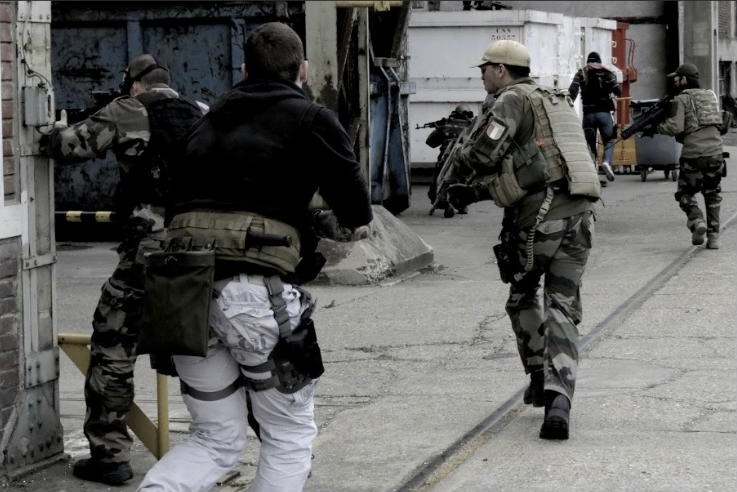
Indoors, the whole calculus changes — engagement ranges drop to a few meters and the player who hesitates at a doorway usually loses. Patrol Base's CQB guide and NOVRITSCH's breakdown of CQB basics both center on the same core technique: "slicing the pie" — clearing a room in narrow visual segments around the pivot point of a corner, instead of stepping out wide into the open doorway all at once. A few habits both sources agree on: let your muzzle lead your peek rather than exposing your whole body first, vary your stance and angle so you're not predictable, and once you're spotted, commit — speed and decisiveness beat hesitation in a small room every time. Both guides are explicit that this is simplified, recreational-context guidance, not a substitute for real law-enforcement or military CQB training — which is exactly the right way to think about it.
Squad Roles: Why "Everyone's a Rifleman" Loses Games
A squad where every single player is trying to be the aggressive rifleman is a squad with no depth. Real infantry fire teams build in role separation — team leader, rifleman, automatic rifleman, grenadier — a structure documented in FM 3-21.8 and echoed in airsoft-specific writing. Fox Airsoft's piece on the designated marksman role describes the DM as sitting in the gap between rifleman and sniper — semi-auto only, engaging at ranges the CQB players can't reach, with real engagement-distance discipline instead of just "the guy with the scope." OneTigris's overview of squad positions covers the fuller set of roles worth assigning if your group plays together regularly, rather than everyone showing up and independently deciding to be an assaulter.
Communication Beats Marksmanship
A team that talks to each other beats a team of good shots that doesn't, consistently. NOVRITSCH's communication guide lays out the practical toolkit: hand signals for CQB and short ranges where noise gives you away, verbal callouts, and radios for anything spread out — plus the unglamorous but critical parts, like a five-minute squad briefing before the round starts, agreeing on a frequency in advance, and keeping your radio callsigns short. If you're running radios, Popular Airsoft's guide to basic radio procedure and Tattica Six's rundown of brevity codes and callsigns are both worth a read — brevity matters because a ten-second radio call is ten seconds you weren't watching your lane.
Tactics by Game Mode
The right move depends heavily on what you're actually playing.
| Mode | What actually works |
|---|---|
| CQB / Indoor | Stack tight at doorways, slice the pie around corners, gun leads your peek, commit hard once compromised, always carry a sidearm as backup. |
| Woodland / MilSim | Wedge formation with a point man out front, 5–10m spacing between players so one burst can't tag your whole team, bounding overwatch across open ground, quiet "fox walk" footwork near suspected enemy positions. |
| Objective-based | Split roughly 60/40 between pushing the objective and holding your flanks — don't commit the whole squad forward. Whoever's carrying the objective item should be escorted, not fighting. Plan your route and a fallback lane before the round starts. |
All three drawn from Airsoft Shot Timer's tactics guide, cross-referenced against the CQB and comms sources above.
Terms Worth Knowing
A short glossary if any of the above was new vocabulary:
- Bounding overwatch — leapfrog movement where one element covers while another advances.
- Cover vs. concealment — cover stops projectiles, concealment only hides you from sight.
- Peel (including "Australian peel") — a fighting withdrawal where players fall back one at a time while the rest cover them; the Australian variant does the same thing sideways instead of straight back. (Airsoft GI glossary)
- MED (minimum engagement distance) — the closest range a given weapon/FPS is allowed to fire at; closer than that typically means switching to a sidearm or calling the hit. (High Speed BBs)
- Blind fire — shooting without actually seeing your target, e.g. blindly around a corner. Banned at most fields. (High Speed BBs, above)
- Hemming fire / "lead faucet" — heavy, sweeping suppressive fire across an area to keep the other side's heads down. (Airsoft GI glossary, above)
- AO / FOP / OP / ROE — Area of Operation, Forward Observation Point, Observation Post, Rules of Engagement. (Duell Tactical glossary)
Mistakes That Cost New Players Games
The same handful of errors show up over and over in beginner-focused writeups from Amped Airsoft, Airsoft GI, and Airsoft Newb: standing to shoot when kneeling or prone would work just as well, moving alone instead of staying in sight of a teammate, tunnel-visioning on the enemy in front of you while your flank goes unwatched, not communicating a spot report the instant you see someone, and — a big one — poor trigger discipline that gives your position away with wasted shots. None of these need better gear to fix. They need slower, more deliberate decisions.
Where This Comes From — Real Manuals Worth Reading
If you want to go deeper than a blog post, the airsoft milsim community draws directly on real, public-domain US Army doctrine — this isn't secondhand advice, it's the actual source material. TC 3-21.76, the Ranger Handbook, is the official, freely downloadable Army manual that a community-written resource called A Tactics Manual for Airsofters explicitly adapts for milsim play — covering movement, patrols, and battle drills. FM 3-21.8 (squad and platoon tactics) and FM 21-75 (cover, concealment, and camouflage) round out the doctrinal backbone behind most of what's in this article. UNITAF's Force Manual is a genuinely well-written, actively maintained tactics doctrine from an established milsim organization, and NOVRITSCH's blog is about as close as the airsoft world gets to a widely-trusted, ongoing tactics resource. There's also a purpose-written paperback aimed at this exact audience, Airsoft Milsim Tactical Training Manual — a real, commercially available title, though we haven't independently verified everything inside it, so treat it as one more resource to weigh rather than gospel.
Worth saying plainly: there's no single global body that governs airsoft tactics or safety rules. Every field and every organized op sets its own standards. Treat everything above as a real, well-sourced starting point — then check the specific rules of wherever you're actually playing.
The Honest Part
Tactics don't fix bad gear, and bad gear undermines good tactics. Slicing a corner or holding a bounding position for thirty seconds under load is a lot harder when your helmet's sliding over your eyes or your retention strap is digging into your jaw. That's the whole reason we obsess over fit and retention on every build — the best flanking maneuver in the world doesn't matter if you can't see out of your own helmet while you're running it. If you're gearing up for something with a night phase, our piece on what a helmet actually needs for a multi-day op is the natural next read.